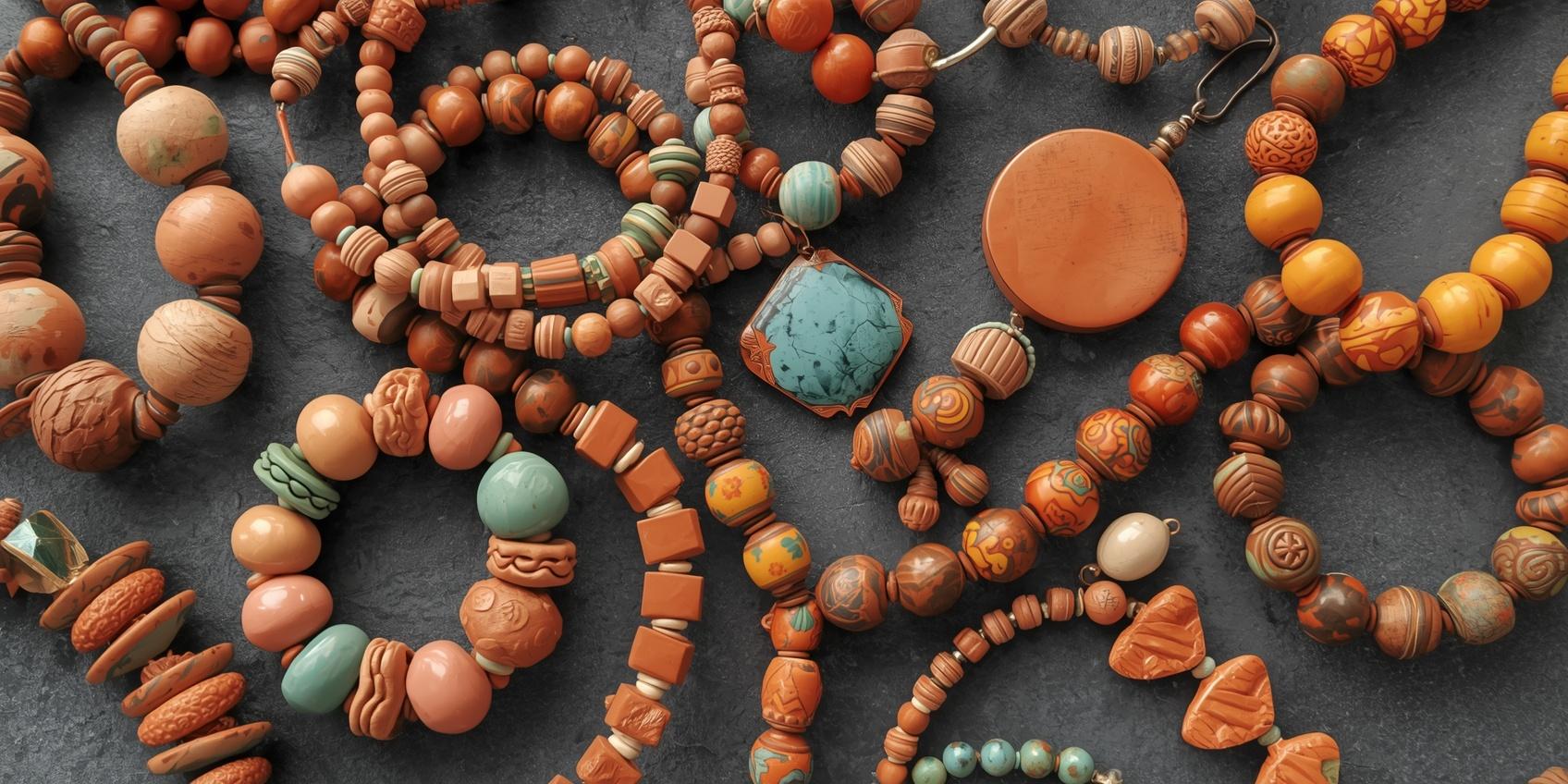
A terracotta bead is a small argument: that the land can become jewellery without a factory, that colour can come from iron and flame, and that a fingerprint in the clay is how you know a person was there.
Earth, fire, and the fingerprint
The clay is not a blank
In the villages we walk with, clay is not shipped in as a neutral powder. It is dug, cleaned, and kneaded until it will hold a hole. That hole must be made while the bead is still soft. Miss the window and you have a pretty stone that cannot join a necklace. Children in craft houses learn this the way other children learn not to slam a door: by watching, then by doing, then by spoiling a few beads and starting again.
There is no synthetic shortcut that keeps this honest. A plastic core with a clay-coloured skin is a different object, made for a different kind of margin. House of Dhrti does not sell that object. If a piece is listed under Dhṛti, it has been through earth and fire in a household that still owns the technique.
Fire is a teacher with no dashboard
Kilns here are wood or coal, watched by people who have learned temperature without a glowing number on a wall. Too little heat and the piece stays fragile. Too much and it warps or darkens in ways the painter cannot save. The terracotta colour — that particular warmth — is iron in the clay meeting the atmosphere of the firing. Dye is not invited to impersonate that meeting.
After the fire, the brush. Motifs of temple borders, owls, daisies, rangoli geometry, tribal line-work: these are not “prints applied.” They are paint on a slightly thirsty surface, which is why two earrings in a pair will never be photocopies. We ask you to see that as authenticity. A marketplace that only rewards sameness will always punish this craft.
“Clay remembers the hand. We do not hide the fingerprint — that is how you know it is ours.”
Why a middleman is a problem of time
When a trader stands between a kiln and a listing, the first thing to be squeezed is hours. Paint becomes thinner. Drying is shortened. Firing is rushed. The object still photographs. It simply does not last, and the household is paid as if the work were simple. Direct partnership is not a slogan on this site. It is how we refuse that squeeze. Pay follows the days the set actually took, and the years it took to learn not to crack a bead in the kiln.
Amazon as the door, not the story
We are not building a checkout here. Fulfilment — packing, tracking, returns — lives on Amazon, where the buyer already knows the path. This page, and the terracotta collection it belongs to, is for the part Amazon cannot hold: the village, the season, the reason a set costs what it costs. If you take a piece home, you are not collecting a trend. You are keeping a kiln relevant for another season.
How to look at a set
Look at the back of a pendant, not only the face. Look at whether the paint sits on fired clay. Feel the weight — terracotta should be light, not hollow-cheap. Accept a small wobble in a line. Then, if you want it, walk through to Amazon. The hands that made it will not meet you at the door. They will be in Eastern India, mixing the next batch of clay.
Pieces from this story
The same clay, the same firing, live on Amazon. Open a card for the motif; buy the set where fulfilment already lives.